



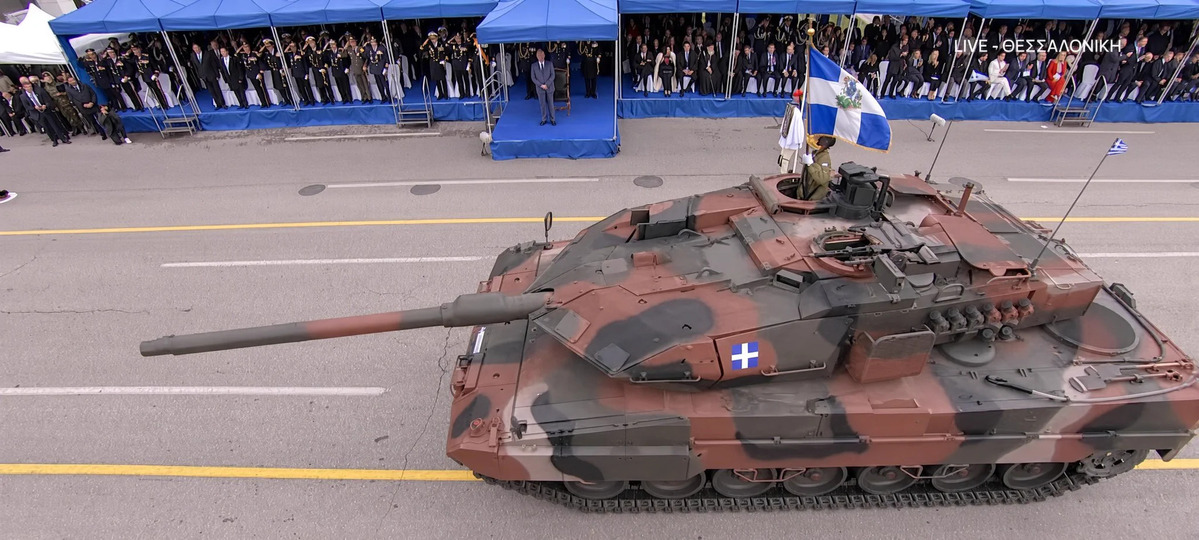
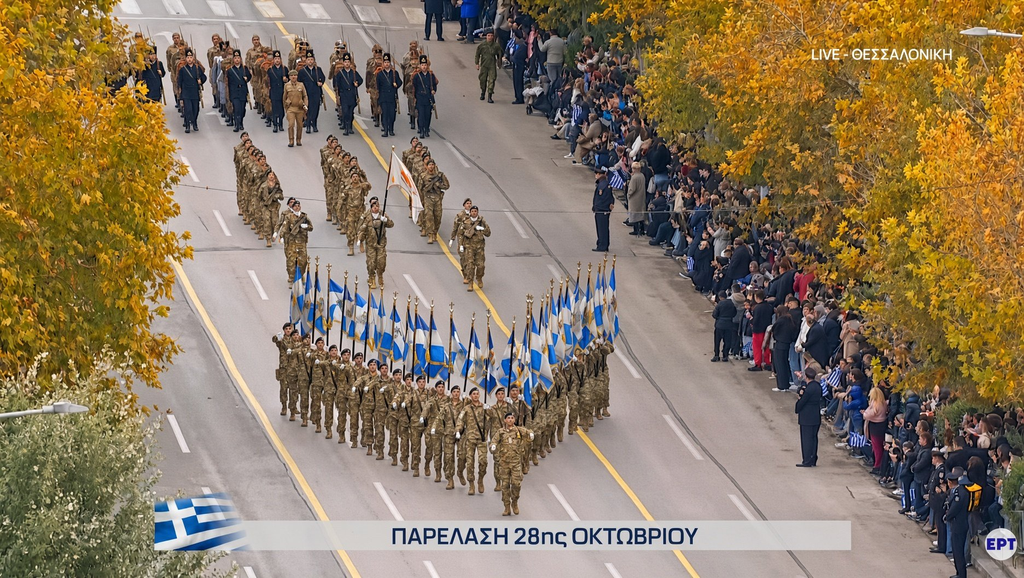
On Wednesday 28 October 2026 the Hellenic Armed Forces held the annual Ochi Day military parade along Megalou Alexandrou Avenue on the Thessaloniki waterfront. Tanks, Soldiers and Fighter Jets flybys were all there, but this year the parade was really about something else: the first public look of new systems currently on order, like subsystems for the Achilles Shield, and systems that are designed by Greek companies or the Armed Forces..
For the second year in a row the Armed Forces’ New Weapons Systems and Innovation directorate had its own section in the parade, and it was by far the most interesting part of the day. A large screen opposite the reviewing stand also showed live feeds from two drones, one over the parade and one on patrol over the eastern Aegean, a nice touch that fits the theme of the whole event.
Below is a walkthrough of the systems that appeared for the first time, grouped by role.
Achilles Shield
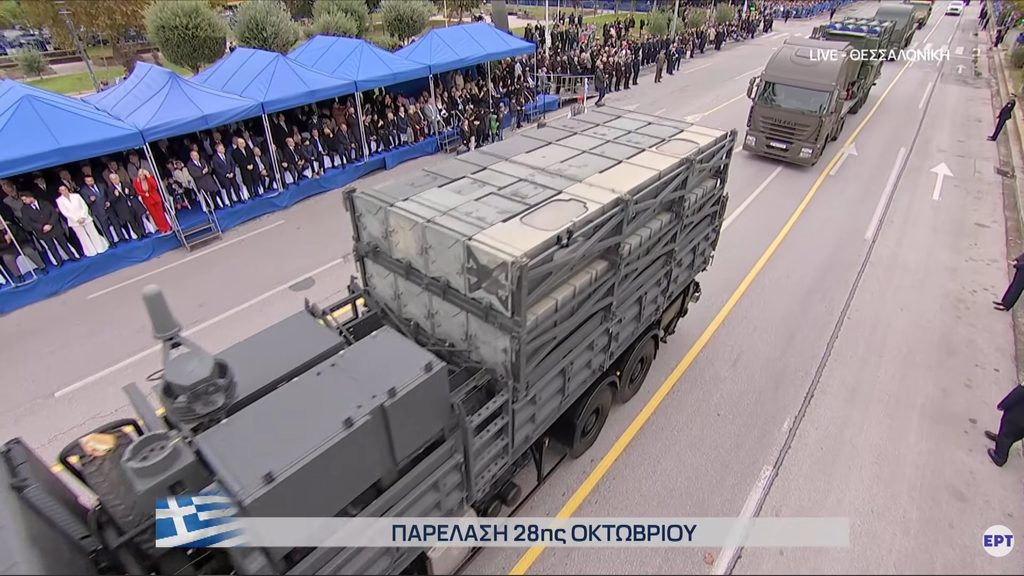
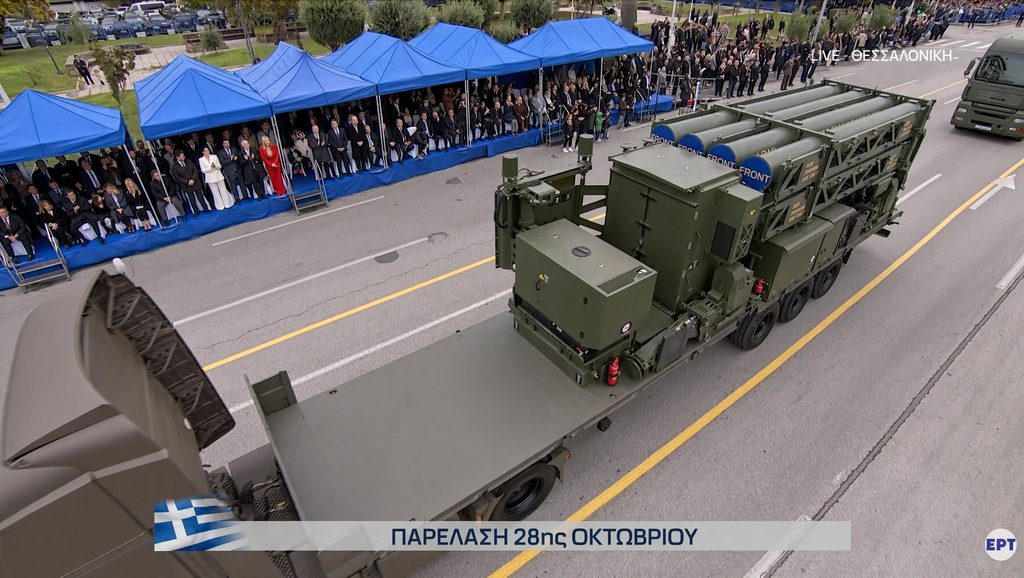
The headline items were the three Israeli air defence systems Greece contracted at the end of August 2026 in a deal worth roughly €3 billion, together with ELTA radars and new command and control system. Only two months after signature, launchers and missile models were already rolling down the main street of Thessaloniki.
| System | Layer | Maker | Key figures |
|---|---|---|---|
| SPYDER | Short / medium range | Rafael | AESA radar, 360°, detection 150+ km, engagement up to 80 km, DERBY and PYTHON missiles |
| BARAK MX | Medium range | IAI | Interceptors of 35, 70 and 150 km range, active radar seeker in the terminal phase |
| David’s Sling (STUNNER) | Upper / anti-ballistic | Rafael | Up to 130 km range, 15 km altitude, Mach 7.5, hit-to-kill |
| Drone Dome | Counter-UAS | Rafael | SIGINT/IMINT, GPS and datalink jamming, cameras and radar picture |
SPYDER is an all-weather system built around a multifunction AESA radar with 360° coverage, able to detect and track targets at 150 km or more and to plug into the wider air control network. It fires the active-radar DERBY and the infrared PYTHON, and its passive EO/IR tracking lets it engage without emitting. The quoted 80 km engagement range points to the medium-range configuration with the extended range DERBY rather than the shorter range versions (15, 20 and 40 km have been reported in the Greek press for the different variants), something worth keeping an eye on as the exact Greek configuration becomes known.
BARAK MX is already a familiar sight in the region, as Cyprus operates it and showed it publicly for the first time in its own parade at the beginning of October. The launcher can carry missiles for three range bands (roughly 35, 70 and 150 km) and engages aircraft, drones, cruise missiles, guided munitions and tactical ballistic missiles. All its interceptors switch on their own radar seeker in the final phase of the flight. A common Greek-Cypriot Barak MX architecture is one of the more interesting possibilities this choice opens up.
David’s Sling was represented by a vehicle carrying the STUNNER interceptor. STUNNER has a two-stage solid rocket motor, no warhead at all (it kills by direct impact) and a dual EO/IR and radar seeker in its asymmetric nose. The figures given were interception at up to 130 km, at altitudes up to 15 km and speeds up to Mach 7.5. Greece becomes only the second European operator after Finland, and the system comes with recent combat experience from the war with Iran earlier this year. Alongside the Patriot batteries, it will form the upper tier of the shield.
Rounding off this group was the Drone Dome command and control vehicle, bought under a separate contract. It does signals intelligence and some imagery intelligence, and can jam the GPS, communications and navigation of hostile drones in selected frequency bands, with cameras and a radar picture for the operators.
PULS MLRS
The PULS rocket launcher, of which Greece ordered 36 last year for about €650 million, also made its parade debut. With a stated reach of up to 300 km it is the longest-range land strike system the Hellenic Army has ever fielded, a big step up from anything the current MLRS fleet can do, and a key piece for the islands and the Evros front.
Counter-drone and electronic warfare
The lessons of Ukraine and the Red Sea were clearly visible in this part of the parade:
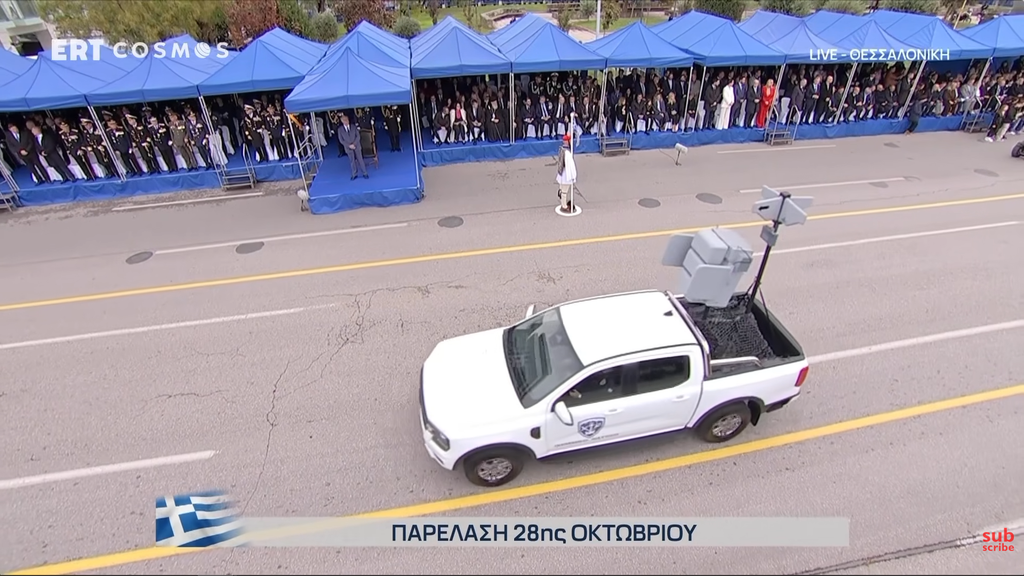
- Kentavros (Centaur): Greek anti-drone system developed by the Hellenic Centre for Defence Innovation (ELKAK) and the Hellenic Aerospace Industry (EAB), coordinated by the Navy’s UAV Command. It has already been tested at sea on Hellenic Navy frigates in the Red Sea during EU Operation Aspides, and has reportedly been demonstrated integrated with Barak MX.
- Yperion (Hyperion): EAB’s own counter-drone system, in advanced testing, for fitting either on ships or at land bases.
Drones
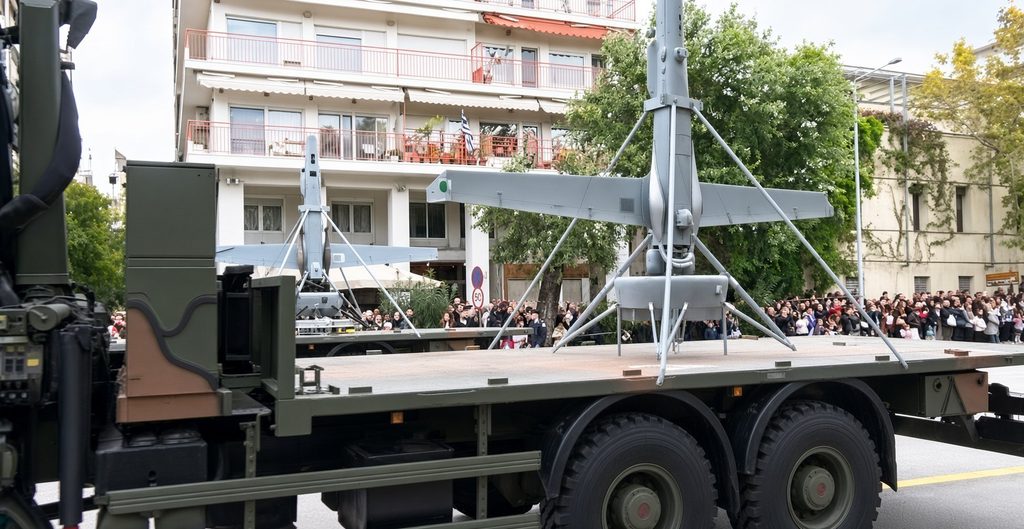
- V-BAT: a tail-sitter VTOL UAV by the US company ShieldAI , 3.8 m wingspan and 2.9 m length, top speed 139 km/h, endurance up to 12 hours and an operating radius beyond 200 km.
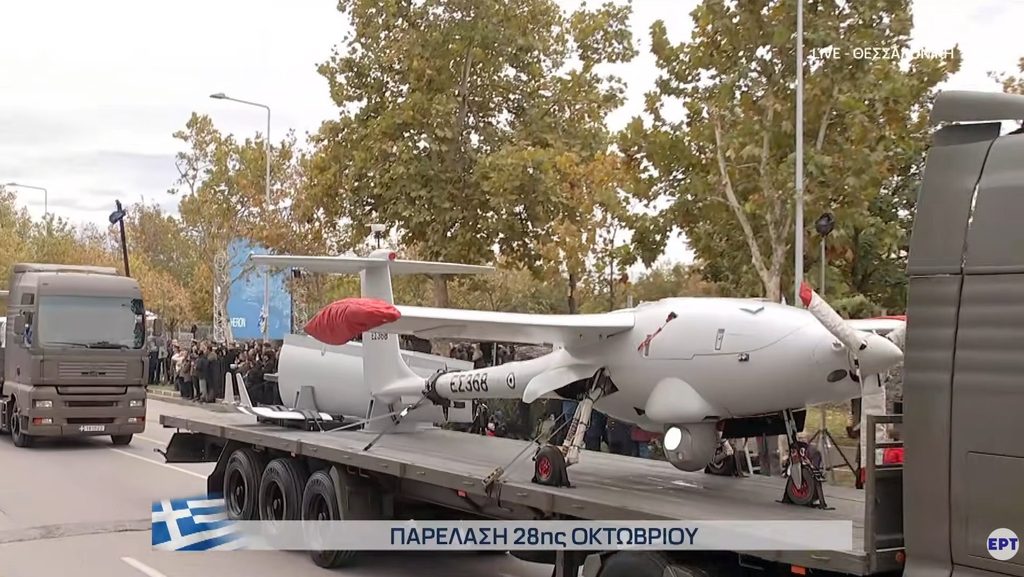
- Patroller: French long-endurance UAV for surveillance, target recognition and intelligence, with an EO/IR payload and real-time datalink.
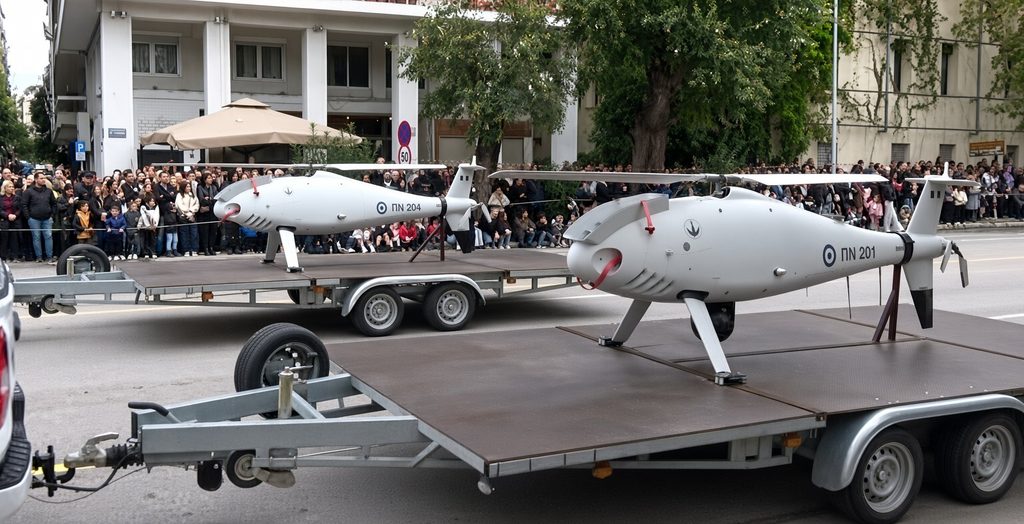
- Camcopter S-100: Schiebel’s rotary-wing UAV, which will first operate from the new FDI HN (Kimon class) frigates, giving them over-the-horizon situational awareness.
- Archytas: VTOL UAV developed by the Naval Academy, the NTUA School of Electrical and Computer Engineering and Greek private companies, able to work from land or ships.
- A-900: VTOL UAV for Fleet units and land bases, with EO sensors and real-time transmission of the surface picture.
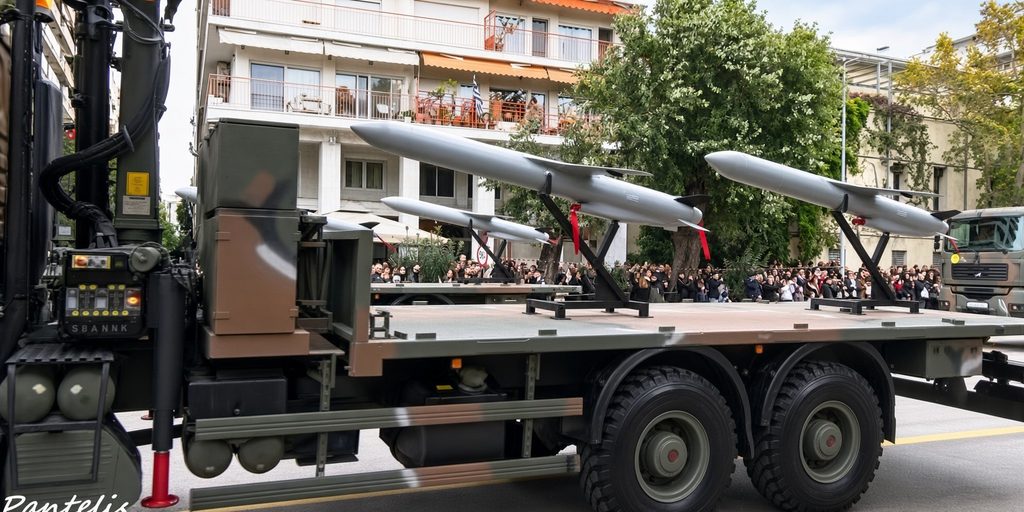
- Arpyia (Harpy): Greek-designed mini cruise missile / one-way attack UAV, flying pre-programmed low-altitude profiles with a very low radar cross-section at high subsonic speed. No numbers were released and development has not been reported as complete. The minicruise models are most likely based on the target drones produced by Ether based on Crete.
At sea and below it
The Navy brought one of the largest groups of new systems:
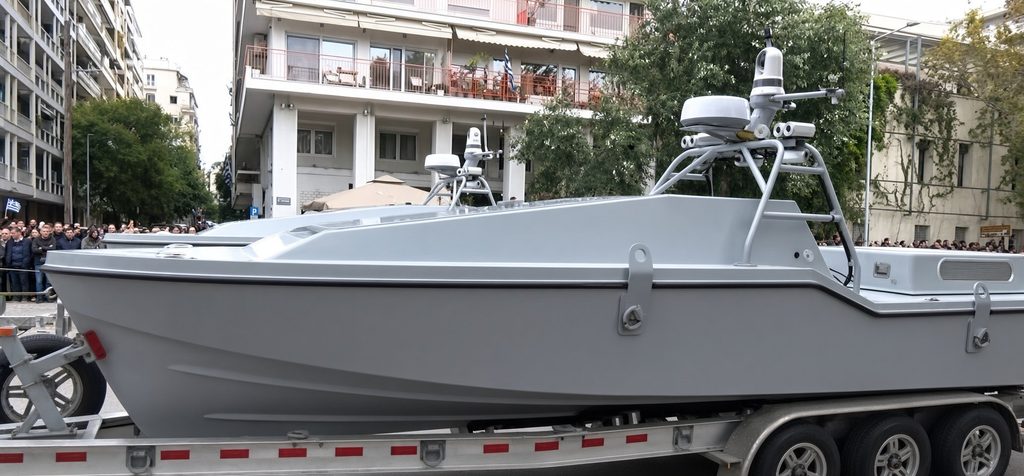
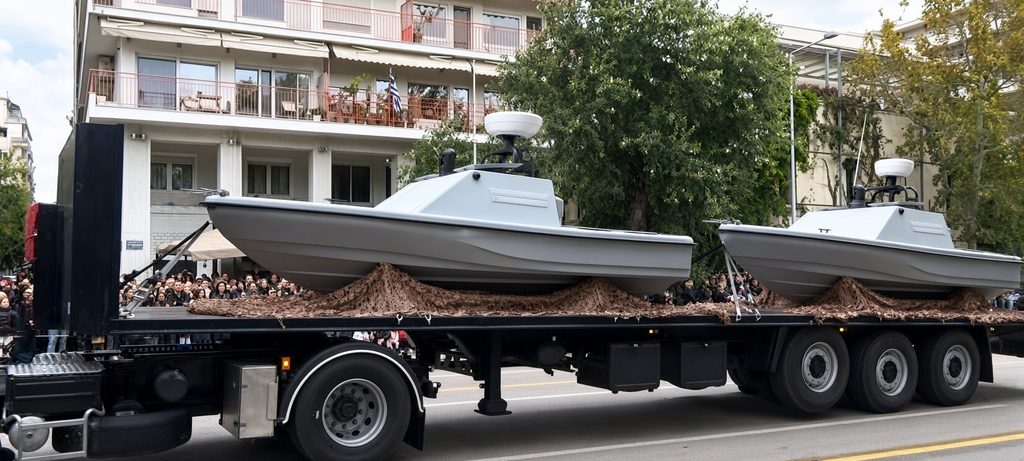
- Anemogiannis: Greek USV for sea denial and attacks on enemy ships, launched from shore or from a ship. Low profile, EO/IR sensors, inertial and autonomous navigation, satellite and radio links, top speed 75 km/h and a 50 kg warhead.
- Pyrpolitis: designed by the Hellenic Navy itself, a 5 m USV doing up to 40 knots with high endurance, carrying an EO system, a surface radar and communications for ISR, anti-surface warfare and one-way attack. Further upgrades are planned.
- Corsair: autonomous surface vessel from the US company Saronic, for surveillance, intelligence and data sharing, operating alone or under operator control. According to the information presented at the parade, it has already been used by the US Navy in the Strait of Hormuz to rescue a helicopter crew. According to Naval News, the nay will order 30 of them from Saronic.
- Victa: hybrid surface/submersible craft for covert insertion of special forces, carrying two crew and six passengers, 40 knots on the surface, 8 knots submerged and down to 30 m.
- Plutino and Pluto Gigas: Italian mine countermeasure vehicles. Plutino is the light member of the Pluto family for shallow water, working as an ROV or fully autonomously with a mine-hunting sonar and HD camera, and it can also be expended as a kamikaze charge. Gigas is the top of the range for deep water, carrying explosive or cutting tools, with eight thrusters that keep it in position in currents up to 5 knots.
- Seahake Mod 4: ATLAS Elektronik’s heavyweight submarine-launched torpedo, wire (fibre-optic) guided throughout its run, effective in both deep and shallow water and highly resistant to countermeasures.
- Rotinor Divejet: electric underwater scooters for the Navy’s Underwater Demolition Teams, quiet and fast with precise navigation.
On land
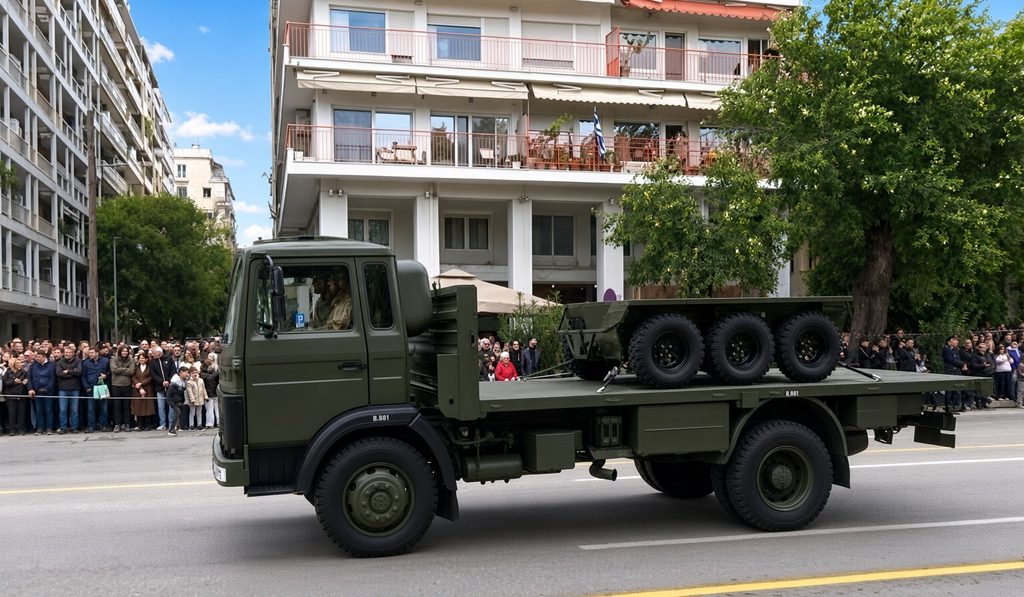
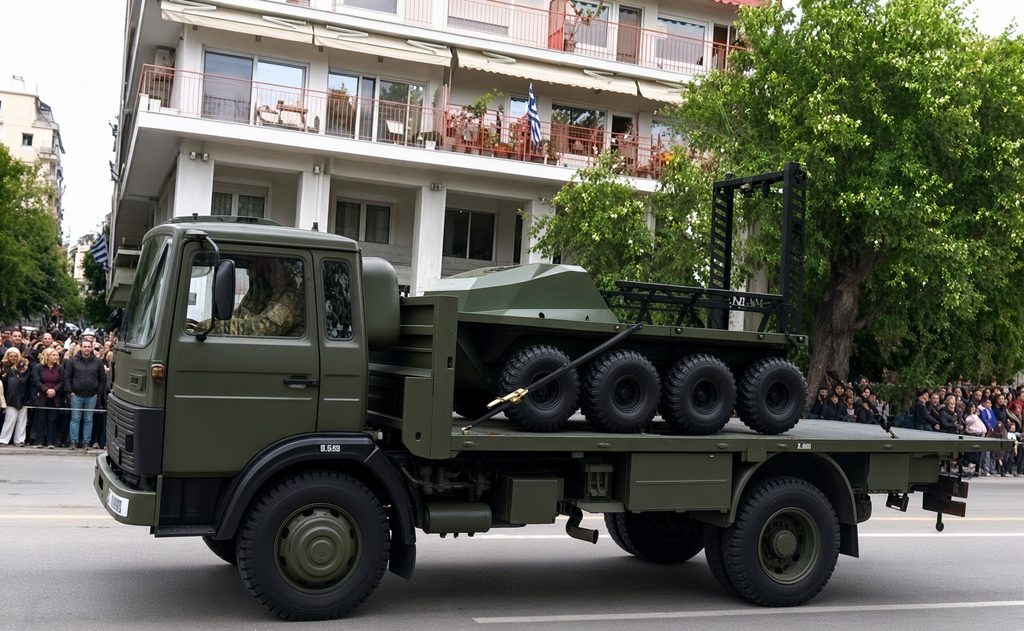
- Anteos: Greek 6×6 UGV for resupply, casualty evacuation, surveillance, reconnaissance, communications relay and weapons carriage, with a 600 kg payload, up to 8 hours endurance and low acoustic and thermal signatures.
- Agema: fully amphibious UGV for rivers, lakes, marshes and flooded ground, for search and rescue, cargo and route surveillance with thermal cameras, using AI-based autonomy.
Command, communications and disaster response
A final group showed that the Armed Forces are also preparing for civil emergencies, which in Greece mostly means wildfires and floods:
- Deukalion: tactical disaster command and control station on a 400 hp MAN 6×6, with a six-person work room and a separate leadership meeting room. It talks to ground, naval, air and civil protection units, reaches the classified defence network through HELLAS SAT 4, and carries two UAVs plus a thermal/optical camera streaming live to the General Staff’s joint operations centre.
- Amfiktyon: mobile communications station on a Mercedes-Benz Sprinter with a telescopic antenna mast, supporting both military operations and populations hit by disasters.
- Metoikos: portable communications node designed and built by the Air Force’s telecommunications and electronics factory, handling satellite, microwave, 4G/5G LTE and wired IP links. It runs for 13 hours on its own generator and sets up in 45 minutes to 3 hours.
- Mobile First Aid Station: a self-contained medical cabin for emergencies.
This year’s parade was a statement of intent for Agenda 2030. The Achilles Shield systems are real, contracted and coming, and seeing them on the street only two months after signature is a strong message both at home and across the Aegean. PULS gives the Army a reach it never had before.
At the same time, it is worth being careful with the rest of the list. Some of the unmanned systems already serve in the forces, but several of them, such as Anteos, Agema and Corsair, have no announced contract, and for Greek designs like Anemogiannis, Pyrpolitis and Arpyia completion of development has not been reported. Many specifications were also not released at all. A parade is a showcase, not an order of battle, and the real test will be how many of these prototypes move into series production and actual units.
Still, the direction is clear: layered air defence, long-range fires, and a growing domestic ecosystem of drones, counter-drone and EW systems built by HAI(EAB), ELKAK, the services’ own factories and Greek private companies. If even half of what was shown makes it into service, the Hellenic Armed Forces of 2030 will look very different from the ones that marched in Thessaloniki only a few years ago.